Discounts are the most powerful way to increase sales on Shopify stores, attract shoppers, and encourage purchases. But how do you choose the right offer? Should you offer 20% off or $20 off?
With the right Shopify discount app, merchants can create promotions that match their products, customers, and business goals. The key is to understand when a fixed-amount discount makes more sense, when a percentage discount works best, and how each affects your profit margins.
This is a guide that explores the difference between percentage-off and fixed-amount discounts and examines practical examples. You can also learn to choose the right Shopify discount strategy to improve conversions.
What Is a Percentage Discount?
A percentage discount reduces the original price of a product or order by a specific percentage.
Common examples: 10% off, 20% off, 50% off.
The amount the customer saves will depend on the original price of the order. A customer can get more monetary savings for the same discount percentage if the product they buy is of a higher price.
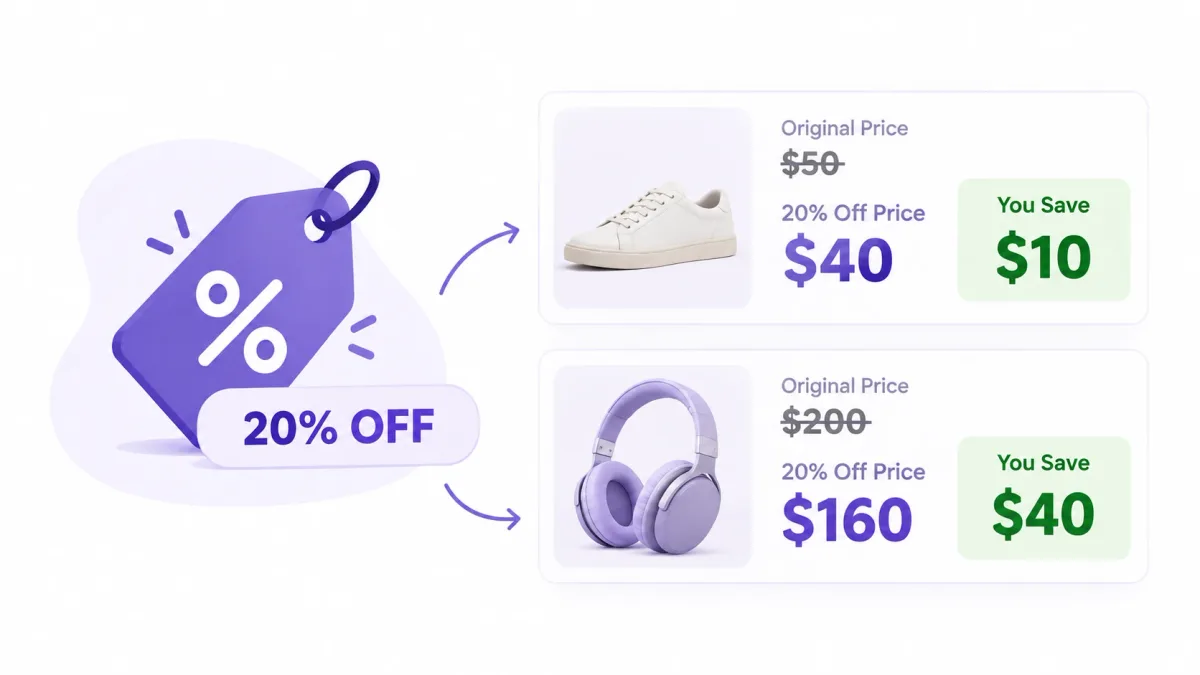
For example, with a 20% discount:
- If the shopper buys a $50 product, they save $10
- If the shopper buys a $200 product, they save $40
When should Shopify merchants use percentage discounts?
Percentage discounts are good for seasonal promotions, storewide launches, product launches, and clearance campaigns. They are easy to communicate to the customer.
Percentage discounts can make an offer look attractive at different price points, especially across a product catalog.
Benefits of percentage-off discounts
- Easy promotion: It is simple to advertise through social media, banners, or email campaigns. You only have to communicate that there is “20% off”.
- Perceived value: If the product price is relatively low, then the percentage can look really attractive.
- Higher cart value: As the discount applies to the entire order, the customer will have a tendency to increase the cart value by purchasing more.
- Flexible application: Merchants can flexibly apply the discount. It can be only for a selected product or for certain eligible orders.
What Is a Good Discount Percentage?
A 10% to 20% discount is generally considered a good discount percentage for most products and ecommerce stores. A 10% discount works well for small promotions or first-time customers, while 15% to 20% can create a stronger incentive to buy. For seasonal sales, clearance offers, or major events like Black Friday, discounts of 20% to 30% or more may work better. The right discount depends on your profit margin, product price, customer expectations, and sales goals.
Percentage Discount Examples
Let us take a look at the different ways to offer percentage discounts, and how different offers can affect the final price.
- 10% off: a $40 product costs $36. Customer saves $4
- 20% off: a $75 product costs $60. Customer saves $15
- 30% off: a $100 product costs $70. Customer saves $30
- 50% off: a $120 product costs $60. Customer saves $60
Based on the kind of discount percentage that you provide, it can determine the value of savings for the customer.
How do percentage discounts increase conversions?
Consider a Shopify store selling clothing, accessories, and home products. The merchant wants to make the promotions more noticeable. It can be for a shopping event like Black Friday, Cyber Monday, or even for a seasonal clearance sale. A percentage discount is the best way to do this.
Research published in the Journal of Retailing shows that percentage-based promotional messages could be more appealing when the perceived discount benefit was high. However, note that customer responses depend more on the product and the way in which the offer is presented.
As a merchant, you should carefully plan before launching any percentage-off promotion. Consider your profit margins as well.
What Is a Fixed Amount Discount?
A fixed amount discount reduces a specific amount from the original price or from the eligible order total. It is also referred to as a flat discount or a dollar-off discount.
For example:
- $10 off any order
- $25 off an order of at least $100
- $50 off a certain premium product
For an eligible purchase, the monetary value of the fixed discount remains the same. If it is a “$10 off” promo, no matter how much the total order value is, the customer only gets a $10 discount. It does not change like a percentage discount.
When should Shopify merchants use fixed amount discounts?
Fixed amount discounts are commonly used to encourage customers to reach a minimum spending threshold. They can also work well for loyalty rewards and higher-priced products. Merchants also use them for customer retention campaigns.
It is useful if the merchant is trying to communicate the potential savings to a customer in concrete terms. A “Save $40 today” instantly tells the customer how much money they can save.
Advantages of fixed amount discounts
- Clear savings: Shoppers can clearly and easily understand the monetary benefit.
- Customer loyalty: A personalized $15 reward can feel more tangible. It is way better than offering an equivalent percentage offer.
- Predictable discount costs: Merchants know the amount deducted for each eligible promotional price reduction.
- Effective high-value offers: If there is substantial savings, it can make any expensive product look more appealing.
Fixed Amount Discount Examples
Let us look at the various examples of fixed amount discounts, and how they apply to different orders.
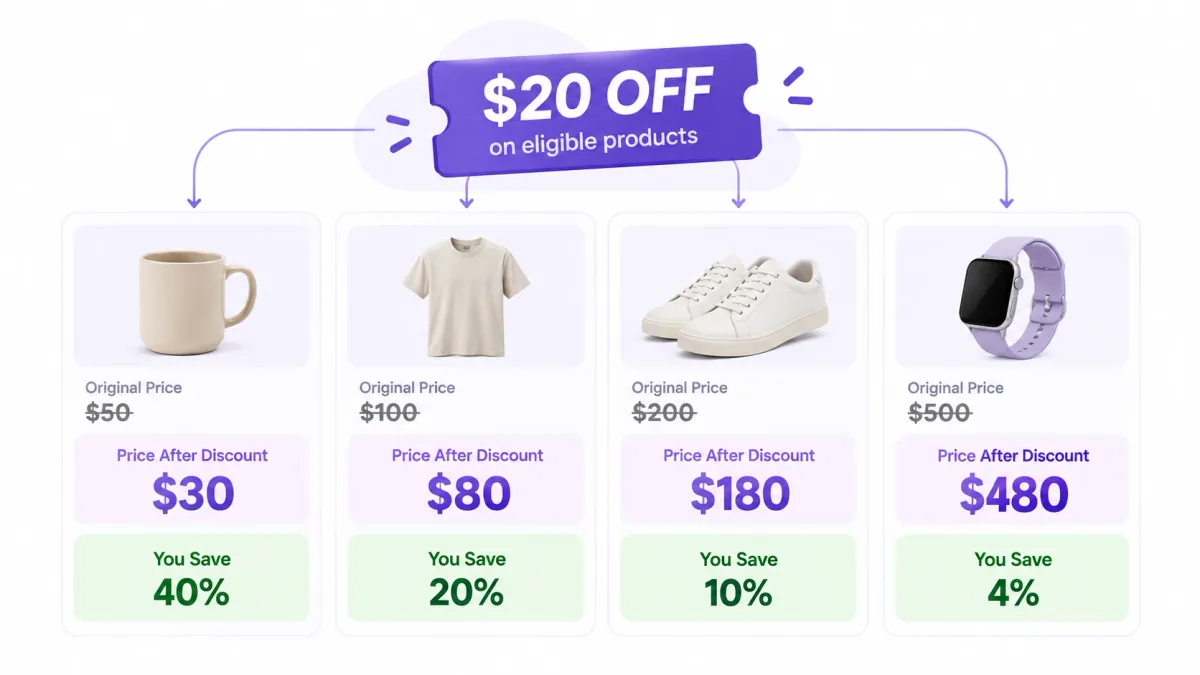
With $20 off eligible products:
- $50 product: the customer pays $30. Saves 40%
- $100 product: the customer pays $80. Saves 20%
- $200 product: the customer pays $180. Saves 10%
- $500 product: the customer pays $480. Saves 4%
The discount remains a constant $20. However, its relative value changes depending on the original price of the order.
Percentage Off vs Fixed Amount Difference
| Factor | Percentage discount | Fixed amount discount |
|---|---|---|
| How it is calculated | A percentage off the eligible price | A set amount is deducted |
| Example | 20% off | $20 off |
| Best suited for | Storewide sales, different product ranges | High-value products, targeted rewards |
| Discount cost | Increases with eligible spending | Remains fixed per eligible redemption |
| How the customer looks at it | Attractive for lower-priced items | Compelling for higher-priced items |
| Cart-building potential | Savings can grow with spending | Tiers and thresholds can encourage larger carts |
| Margin management | Monitoring is needed for larger discount amounts | Offers more predictable per-redemption costs |
Percentage vs Fixed Discounts: Which Converts Better?
There is no universally superior option. The discount that converts better depends on products, audience, margins, and the objective of your promotion.
If you are promoting affordable products or running storewide campaigns, percentage discounts can be more effective. If you need the customer to respond better to the savings, then a fixed-amount discount will perform better.
To find out which option converts better for your individual store, you can test both with comparable conditions.
How to choose the discount based on my business goal?
Here are some practical recommendations that you can consider:
- To increase conversions: Test percentage discounts on lower-priced products. Test fixed-amount discounts on higher-priced products.
- To encourage repeat purchases: Test a fixed-amount discount for returning customers. Test personalized percentage offers.
- To increase average order value: Test percentage discounts on eligible orders. Test tiered fixed-amount offers.
- To protect profit margin: Compare the total discount cost, product cost, and resulting contribution margin. All this needs to be done before the promotion launch.
- To clear excess inventory: Test a prominent percentage discount with a substantial markdown.
How do I know which offer runs the best for my Shopify store?
You can find this out by running an A/B test. It can be done by dividing comparable shoppers into groups and showing each group a different offer.
Try to keep the factors as consistent as possible. You can include product selection, audience characteristics, and campaign timing.
Metrics to track are as follows:
- Conversion rate: Percentage of visitors who complete a purchase
- Average order value: Average amount spent per order
- Revenue per order: Revenue generated by each visitor
- Profit per order: Remaining profit after discounts and other costs
- Discount redemption rate: Proportion of eligible shoppers who use the offer
Best Shopify Discount App for Percentage vs Fixed Discounts
A Shopify discount app can simplify promotional planning for merchants. It helps them configure offers, manage discount campaigns, apply eligibility conditions, and more, depending on the available features of the app.
Merchants do not have to manually calculate every promotion. They can just use the discount tool to organize their campaigns. It also reduces the risk of confusing offer terms. So, what is the best Shopify discount app for percentage vs fixed discounts?
Here are some app capabilities that you can look for while evaluating an app:
- Percentage and fixed amount discount options
- Minimum purchase requirements
- Minimum product eligibility rules
- Support for targeted promotions
- Support for different customer segments
- Clear discount conditions
Why consider NexDiscount for discount management?
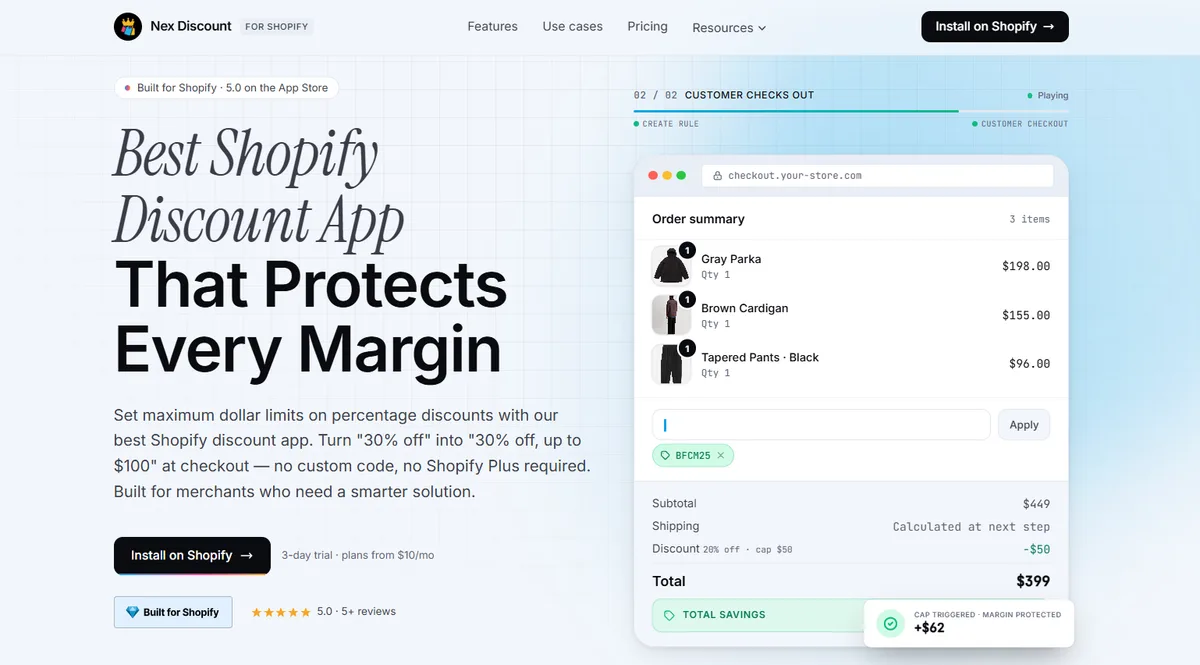
When evaluating conditions for your Shopify discount strategy, NexDiscount is the brand to consider. You can start by identifying the promotions that you need. It can be fixed-amount savings, percentage-off offers, or threshold-based campaigns.
Before you choose a setup, compare NexDiscount’s available features against those requirements. If your goal is to increase AOV, then you can prioritize a discount structure that supports your intended spending thresholds. And if you want to protect margins, then you have to focus on eligibility conditions and the ability to measure results.
Conclusion
When used strategically, both percentage and fixed-amount discounts can drive conversions. The best choice depends on your product prices, target audience, and profit margins. You can test both options to identify which works best for your Shopify store. With NexDiscount, you can explore smarter discount strategies to attract customers, encourage purchases, and support sustainable business growth.
FAQ
What does “percentage off” mean?
Percentage off means reducing the original price by a specific percentage, such as 10%, 20%, or 50%.
What is the best Shopify discount app for percentage and fixed discounts?
NexDiscount is a Shopify discount app that supports percentage and fixed-amount discount strategies with flexible discount conditions.
How to calculate a percent off discount?
Multiply the original price by the discount percentage. For example, 20% off $100 = $20 discount, so the final price is $80.
What are percentage discounts?
Percentage discounts reduce a product or order price by a set percentage, such as 10% off, 20% off, or 50% off.
What is a good discount percentage?
A 10% to 20% discount is generally a good range for most products. The ideal percentage depends on your profit margin, product price, and sales goals.