Does offering a free gift or discount to customers encourage more purchases? Both these strategies can increase sales, but their influence on buying decisions is different. A free gift will make the purchase feel more rewarding, whereas a discount helps the customer save money.
A clear understanding of gift with purchase vs discount can help Shopify merchants create effective promotions. The right Shopify discount app paired with a well-implemented promotional strategy can attract customers without hurting your profits.
Let us explore how these offers work, the psychology behind them, and which strategy can provide better results for your online store.
What Is a Gift With Purchase?
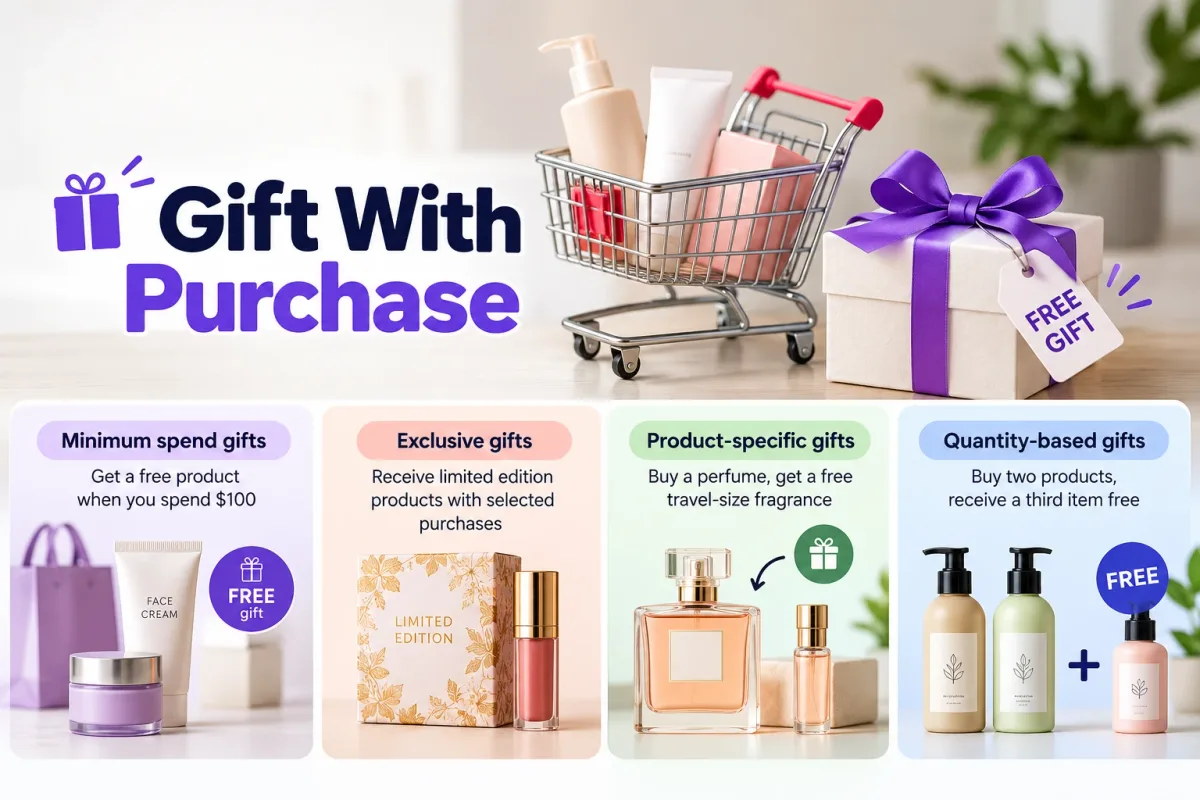
A gift with purchase (GWP) is a promotional strategy that offers customers a free product when they meet certain purchase conditions. Rather than discounting the price of the product, businesses offer something extra to make the purchase attractive.
For example, a skincare brand offering a free moisturizer worth $15 when the customer spends at least $75.
Some of the common free gift with purchase offers include:
- Minimum spend gifts: Get a free product when you spend $100
- Exclusive gifts: Receive limited edition products with selected purchases
- Product-specific gifts: Buy a perfume, get a free travel-size fragrance
- Quantity-based gifts: Buy two products, receive a third item free
Why Do Businesses Offer Free Gifts?
A gift with purchase strategy helps businesses increase the perceived value without lowering product prices directly. It can also encourage customers to explore new products and increase their spending threshold to qualify for the rewards. The customer might develop a stronger relationship with the brand as well.
For example, when a skincare brand offers a free skincare sample, it has the potential to become a product the customer might purchase again.
What Is a Discount?
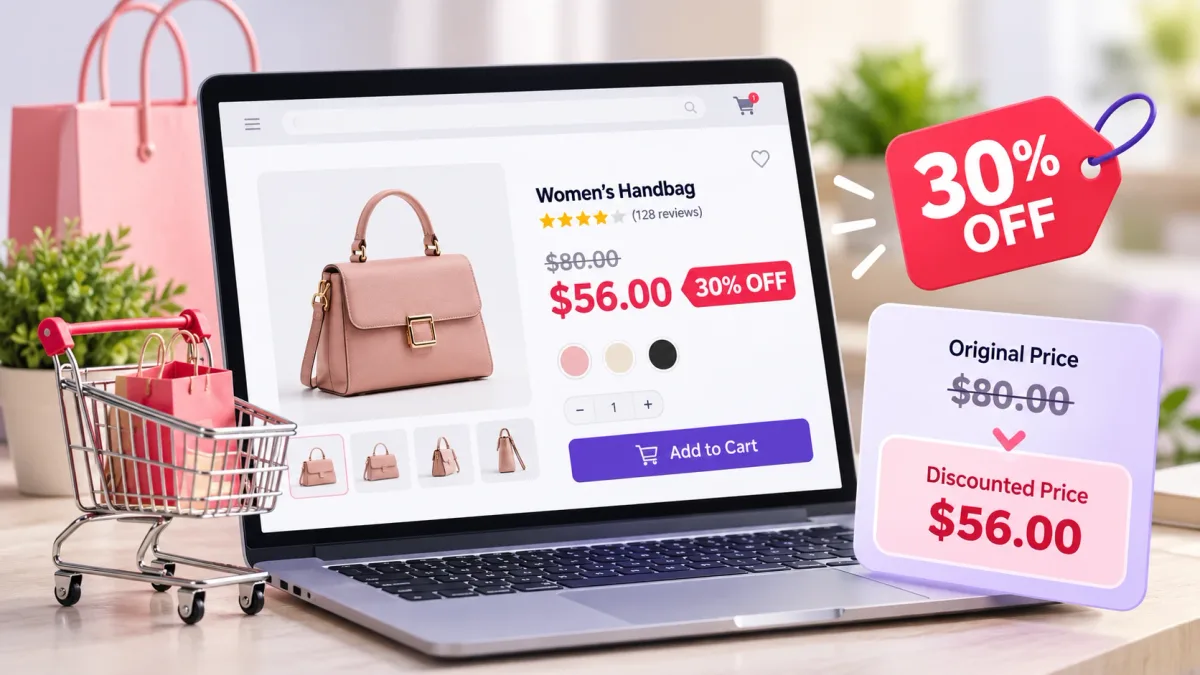
A discount is a promotional offer that reduces the original price of an order or a product. It is one of the most common ecommerce promotions, as it gives the customer an immediate financial benefit.
The most used discount types by businesses are as follows:
- Fixed amount discount: Get $10 off orders above $50
- Percentage discount: Save 20% on your purchase
- Volume discount: Buy 3, save 15%
- Tiered discount: Spend $100, save 10%
Discounts are useful to encourage first-time purchases and attract price-conscious customers.
Gift With Purchase vs Discount: What Is the Difference?
The major difference between a gift with purchase and a discount is the way customers receive value. Both are effective purchase incentives. However, their impact on business profit and customer behavior can vary.
| Factor | Gift With Purchase | Discount |
|---|---|---|
| Customer benefit | Receives additional product | Saves money |
| Perceived value | Adds value to purchase | Reduces the purchase cost |
| Psychological appeal | Excitement, reward | Savings, affordability |
| Profit impact | Depends on gift and fulfillment costs | Depends on discount amount |
| Product pricing | Maintains original price | Lowers selling price |
| Average order value | Encourages spending to unlock gifts | Encourages spending through thresholds |
| Best suited for | Premium products, product discovery, loyalty | Flash sales, customer acquisition, clearance |
| Main challenge | Choosing gifts that customers actually want | Avoiding excessive price reductions |
The Psychology Behind Discounts
Why do shoppers find discounts attractive? Discounts influence the way a shopper analyzes price, recognizes savings, and makes purchasing decisions. This is consumer psychology.
Discounts Create a Feeling of Saving Money
Customers always compare the original price with the discounted price to see whether they are getting a good deal.
For example, a product marked down from $100 to $75 is a visible saving of $25. These kinds of comparisons make the purchase feel more financially rewarding.
Discounts Create Urgency
Limited-time discounts urge customers to make quick purchasing decisions.
For example, “Save 20% Today Only” gives the shopper an obvious reason to act before the promotion ends.
According to Shopify’s 2026 discount strategy guide, citing Salsify’s 2025 Ecommerce Pulse Report, 62% of consumers identified limited-time discounts as the leading reason they complete an order.
Discounts Influence Perceived Savings
The way customers look at percentage discounts and fixed-amount discounts is different.
For example, on a $500 product order, both “Save $50” and “Get 10% Off” give the shopper the same savings. However, their presentation can make one offer more attractive than the other.
The research titled “Amount Off Versus Percentage Off: When Does It Matter?”, published in the Journal of Business Research, says that monetary discounts can be more effective than percentage discounts, especially for higher-priced products.
The Psychology Behind Gift With Purchase

A free gift with purchase can always be more appealing to the shopper. This is because it creates the feeling that they are receiving something extra.
Zero-Price Effect
The word “free” always has a powerful influence on consumer decisions.
A study published in Marketing Science by Shampanier, Mazar, and Ariely in 2007 examined how consumers respond to free products. The research found that a significantly high number of participants chose a product when its price dropped to zero. This phenomenon is known as the zero-price effect.
This clearly suggests that customers may attach an additional emotional value to free products beyond their actual monetary worth.
Gifts Create an Emotional Connection
A gift makes a customer feel appreciated. It provides them with an emotional experience leading to customer loyalty, especially when the gift is useful, relevant, or exclusive.
As gift selection matters, businesses should focus on offering gifts shoppers might actually want.
Free Gift Increases Perceived Value
A free gift gives the feeling that a customer is receiving more for the same amount of money. If a customer is buying a perfume worth $1,000 and they get a complimentary travel-size fragrance, it is more appealing.
It creates a feeling of getting more value from the same purchase.
Gift With Purchase vs Discount: A Simple Example
Let us compare two promotional offers from an online beauty store. Let us say that the store sells a skincare bundle for $100. The business is aiming to increase purchases, and they are considering two promotional strategies.
Option 1: Offer a Free Gift
Offer a complimentary skincare product worth $20 with the same $100 bundle.
- Original price: $100
- Discount: $0
- Customer pays: $100
- Free gift value: $20
There is no price reduction, but the customer receives an additional product.
Option 2: Offer a 20% Discount
Offer 20% off the skincare bundle.
- Original price: $100
- Discount: $20
- Customer pays: $80
Customers get an immediate financial benefit.
Which Is Better for Increasing Sales?
Both of these promotional strategies can increase Shopify sales. However, they serve different purposes.
When Are Discounts More Effective?
If you have any of the following goals, discounts can be very useful:
- Increase short-term sales during seasonal promotions
- Attract new customers with competitive pricing
- Clear excess inventory
- Clear slow-moving inventory
- Encourage hesitant shoppers to complete their purchase
When Are Free Gifts More Effective?
A gift with purchase promotion can be suitable if you are aiming at any of the following:
- Increase average order value (AOV)
- Reward loyal customers
- Maintain the original selling price of the product
- Introduce customers to new products
- Strengthen the perceived value of the brand
According to Shopify reports, the nutrition brand Tropeaka was able to increase its AOV from AU$89 to AU$94 after they introduced a free gift promotion.
How to Choose Between a Gift and a Discount
In order to choose the right discount strategy, you have to be aware of your financial goals, customers, and products.
Consider Target Audience
Price-sensitive customers want to reduce spending, so they may prefer immediate discounts.
If a customer is shopping for a premium product, they might respond more positively to exclusive gifts. It enhances the overall experience.
Evaluate Profit Margins
First calculate how much a promotion will cost your business, then launch it. For gifts, include product costs, packaging, shipping, and other fulfillment expenses. For discounts, consider the reduced selling price.
A low-cost gift with a high perceived value may offer better profitability than a large discount.
Set Minimum Purchase Threshold
Purchase thresholds can encourage customers to increase their cart value.
For example:
- Spend $75, get a free gift
- Spend $100, save $15
If the current AOV is $65, a $75 threshold may encourage customers to add another product.
Use Customer Data to Improve Promotions
Review the performance of the previous campaign. It will help to understand which offer customers prefer. The metrics that can be tracked are conversion rate, average order value, gross profit, and repeat purchases.
A Shopify discount app can help merchants manage promotional campaigns and apply eligible offers. NexDiscount can be a part of the broader promotional strategy of a store. It helps merchants explore many discount-led approaches to match their business goals.
Gift With Purchase vs Discount: Which Converts Better?
When comparing gift with purchase vs discount for conversion rate optimization, there is no clear winner. If a customer values additional products or exclusive rewards, gifts may perform better. If a customer prioritizes affordability, then discounts may convert better.
It is always best to choose after testing both.
How Can You Test Gift Promotions Against Discounts?
Run an A/B test using two comparable customer groups:
- Show a discount offer to one group
- Show a free gift promotion to the second group
Keep as much consistency as possible in:
- Product
- Traffic source
- Campaign duration
Then measure these metrics:
- Conversion rate
- Average order value
- Repeat purchase rate
- Revenue per visitor
- Gross profit per order
Conclusion
Choosing between gift with purchase vs discount depends on your business goals and target customers. Discounts give immediate savings and can promote quick purchases. Free gifts create extra value, protect original pricing, and support product discovery.
With the help of a well-planned promotional strategy and tools like NexDiscount, businesses can create more compelling shopping experiences. They can also work toward higher conversions, sustainable sales growth, and stronger customer relationships.
FAQ
What does GWP mean?
GWP stands for Gift With Purchase. It is a promotion where customers receive a free gift when they meet a specific purchase condition, such as spending a minimum amount or buying a particular product.
Is gift with purchase the same as a discount?
No. A gift with purchase gives the customer an additional product for free, while a discount reduces the price of the purchase. A GWP adds extra value without lowering the original product price.
What are some common pitfalls to avoid in gift with purchase promotions?
The main pitfall is choosing a gift that customers do not actually want. Businesses should also consider the cost of the gift, packaging, shipping, and fulfillment. Setting an unclear or unrealistic purchase threshold can also make the promotion less effective.
How do you choose the right gift for a GWP campaign?
Choose a gift that is useful, relevant, and attractive to your target customers. Consider your product, audience, profit margins, and the cost of fulfillment. A low-cost gift with high perceived value can make a GWP campaign more profitable.